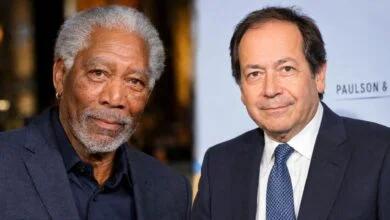
Morgan Freeman and John Paulson Two Remarkable American Success Stories in Entertainment and Finance

Success can take many different forms. For some people, it comes through creativity, storytelling, and the ability to influence millions through entertainment. For others, it develops through financial expertise, strategic decisions, and the discipline to recognize opportunities before they become widely understood. Morgan Freeman and John Paulson represent two very different examples of achievement in American society.
Morgan Freeman is internationally recognized for his distinguished acting career, memorable performances, and unmistakable voice. John Paulson, meanwhile, is known for his work in investment management and his prominent role in financial markets. Although their professional backgrounds have little in common, both have become recognizable figures in their respective industries.
Exploring Morgan Freeman and John Paulson together offers an interesting opportunity to examine how talent, experience, persistence, and strategic thinking can lead to professional success. Their stories also demonstrate that influence does not follow a single formula.
Who Is Morgan Freeman?
Morgan Freeman is one of the most respected actors in American cinema. Born on June 1, 1937, in Memphis, Tennessee, he developed an interest in acting at an early age. His journey to international recognition, however, involved years of training, stage performances, and smaller television appearances.
Freeman’s career demonstrates that professional success does not always happen early. Rather than becoming an overnight Hollywood star, he spent decades developing his abilities and building a reputation through consistent work.
Early Life and Career Development
Freeman grew up in the American South and developed an interest in performing during his school years. He participated in acting competitions and demonstrated an early ability to connect with audiences.
After graduating from high school in 1955, he enlisted in the United States Air Force instead of immediately pursuing a career in entertainment. He served until 1959 before returning to his interest in acting.
His subsequent training and theatrical experiences helped him develop the confidence and discipline needed for professional performances.
During the 1960s and 1970s, Freeman appeared in stage productions and television programs. One particularly important opportunity was his role as Easy Reader on the educational children’s television series The Electric Company. The program introduced his personality and performance style to a much wider audience.
His early experiences provided a foundation for the film career that followed. American Film Institute+2
Breakthrough Performances in Hollywood
Freeman’s career gained considerable momentum with his performance in Street Smart (1987). His portrayal earned him an Academy Award nomination for Best Supporting Actor and brought greater attention to his dramatic abilities.
He subsequently appeared in several critically acclaimed productions, including:
- Driving Miss Daisy (1989)
- Glory (1989)
- Unforgiven (1992)
- The Shawshank Redemption (1994)
- Se7en (1995)
- Amistad (1997)
- Million Dollar Baby (2004)
- Invictus (2009)
- The Dark Knight trilogy
These performances demonstrate his versatility across drama, historical storytelling, crime thrillers, and major commercial productions.
His performance in Million Dollar Baby earned him the Academy Award for Best Supporting Actor in 2005. He also received widespread recognition for Driving Miss Daisy, including a Golden Globe Award.
Freeman’s achievements have established him as an influential figure in American filmmaking. National Endowment for the Arts+2
Beyond Acting: Narration and Cultural Influence
Another important part of Freeman’s professional identity is his narration work. His recognizable voice has become associated with documentaries, television productions, and educational storytelling.
Projects such as March of the Penguins, Through the Wormhole, and The Story of God with Morgan Freeman demonstrate his ability to communicate complex subjects in an engaging way.
His contributions extend beyond performing. He has also worked as a producer and director, demonstrating an interest in the broader creative process behind entertainment.
The National Endowment for the Arts recognized Freeman with the National Medal of Arts in 2015 for his contributions as an actor, director, and narrator. National Endowment for the Arts+1
Who Is John Paulson?
John Paulson is a prominent American financier best known for his investment strategies and his role in the financial markets during the 2007–2008 housing crisis.
Unlike Morgan Freeman, whose professional achievements are rooted in entertainment, Paulson built his reputation through investment analysis, financial research, and managing capital.
His career illustrates how understanding market conditions and identifying financial risks can create significant opportunities in the investment industry.
Early Life and Education
John Paulson was born in Queens, New York, in 1955. His interest in business developed early, and he explored entrepreneurial activities before establishing himself in the financial sector.
He attended New York University, where he studied finance, and later earned an MBA from Harvard Business School in 1980.
His educational background provided a foundation in financial management, business strategy, and investment analysis.
Before launching his own investment firm, Paulson worked at several financial institutions. His professional experience included positions at Boston Consulting Group, Odyssey Partners, and Bear Stearns.
These roles helped him understand corporate finance, mergers and acquisitions, and investment opportunities across different industries. Alumni+1
Building Paulson & Co.
In 1994, Paulson established Paulson & Co. in New York.
The firm initially focused on event-driven investment strategies, which involve identifying opportunities connected to corporate events, financial restructuring, mergers, and market developments.
Rather than relying exclusively on broad market movements, event-driven investors examine specific situations that may create opportunities for potential returns.
Building an investment management business required more than financial knowledge. Paulson also needed to develop relationships with investors, manage risk, evaluate opportunities, and maintain confidence during uncertain market conditions.
His early experience illustrates the importance of persistence in entrepreneurship. Establishing a financial firm does not automatically attract investors. Building credibility and demonstrating a consistent investment approach are essential parts of the process. Alumni+1
The 2007 Housing Market Investment
One of the defining moments in John Paulson’s career came during the American housing market crisis.
During the years leading up to the 2008 financial crisis, the U.S. housing market experienced significant growth. Mortgage lending expanded, and financial institutions created complex securities backed by mortgage payments.
Paulson and his investment team became increasingly concerned about the quality of mortgage lending and the potential risks associated with mortgage-backed securities.
Rather than assuming that housing prices would continue rising, Paulson developed an investment strategy that benefited from declining values in certain mortgage-related assets.
His firm used credit default swaps and other financial instruments to position itself against vulnerable segments of the mortgage market.
When the housing market deteriorated, these positions generated extraordinary returns for the firm and its investors.
The trade became one of the most widely discussed investment decisions associated with the financial crisis. It also established Paulson as a major figure in the hedge fund industry. Alumni+2
Investment Activities and Philanthropy
John Paulson’s influence has extended beyond financial markets.
He has supported educational institutions, cultural initiatives, and public spaces through philanthropic contributions.
Among his notable contributions was support for Harvard University’s School of Engineering and Applied Sciences, which was renamed the Harvard John A. Paulson School of Engineering and Applied Sciences following his major gift.
He has also supported the Central Park Conservancy in New York.
These activities demonstrate how financial success can provide opportunities to contribute to education, research, and community institutions.
Paulson’s career is therefore relevant not only to discussions about hedge funds and financial markets but also to broader conversations about entrepreneurship, wealth, and philanthropy. Alumni
Morgan Freeman and John Paulson: What Connects These Two Individuals?
Morgan Freeman and John Paulson operate in different professional environments, but their names can be explored together through the broader theme of American achievement.
Freeman represents creative excellence, while Paulson represents financial entrepreneurship and investment management.
There is no well-established public evidence of a family relationship, business partnership, or major professional collaboration between them. Their shared appearance in searches should therefore not be interpreted as proof of a personal connection.
Instead, the more meaningful comparison involves their individual accomplishments and the different ways they have developed influence.
Different Industries, Different Forms of Success
Freeman’s career depends on storytelling, artistic interpretation, communication, and audience engagement.
An actor must understand characters, interpret scripts, work with directors, and deliver performances that connect emotionally with viewers. Success often depends on creativity, preparation, and the ability to adapt to different roles.
Paulson’s professional environment requires a different set of abilities. Investment management involves evaluating financial information, studying economic conditions, identifying opportunities, and understanding risk.
While Freeman uses performance to influence audiences, Paulson has used financial analysis to make investment decisions.
Both careers demonstrate that professional excellence requires specialized knowledge and years of experience.
The Importance of Long-Term Development
One particularly interesting similarity between Freeman and Paulson is the importance of professional development.
Freeman spent years working in theater and television before becoming a major Hollywood star. His success demonstrates that building a lasting career can require patience and consistent improvement.
Paulson also developed his financial expertise through education, professional employment, and the gradual establishment of his investment firm.
Neither career can be understood through a single achievement alone. Their reputations developed through a combination of preparation, professional experience, and important opportunities.
Influence Beyond Their Primary Professions
Another point of comparison is their influence outside their main occupations.
Freeman has contributed to film production, documentary storytelling, education, and environmental causes. His recognizable voice and performances have helped communicate stories to audiences across generations.
Paulson has directed part of his financial success toward philanthropic initiatives, particularly in education and public institutions.
Their contributions differ in nature, but both demonstrate that influential individuals can use their professional positions and resources to support activities beyond their original careers.
Comparing Their Careers, Achievements, and Public Recognition
Although both individuals have achieved considerable recognition, their professional journeys are best understood by examining their industries separately.
| Category | Morgan Freeman | John Paulson |
|---|---|---|
| Primary industry | Film and entertainment | Finance and investment |
| Known for | Acting and narration | Hedge fund management |
| Major achievement | Academy Award for Million Dollar Baby | Successful investment against subprime mortgages |
| Professional strengths | Creativity and communication | Financial analysis and strategy |
| Business involvement | Production and entertainment | Investment management |
| Philanthropic interests | Environmental and community initiatives | Education and cultural institutions |
The comparison highlights how different professional strengths can produce influence in American society.
Public Recognition and Legacy
Freeman’s reputation is closely associated with memorable performances and his contribution to American cinema. His work has reached audiences across different generations, making him a familiar figure in international entertainment.
Paulson’s reputation is more closely connected to investment history, particularly the financial events surrounding the housing market collapse.
Their public recognition also reflects the differences between their industries. Actors often become familiar through movies, television appearances, and public performances. Financial professionals generally receive attention through investment results, business decisions, and economic developments.
Understanding these differences helps explain why their professional achievements should not be measured using identical standards.
What Their Stories Teach About American Success
The professional journeys of Morgan Freeman and John Paulson offer several useful lessons for people interested in building successful careers.
First, specialization matters. Freeman developed his acting abilities over many years, while Paulson built expertise in finance and investment management. Both demonstrate the value of developing skills within a chosen profession.
Second, persistence can create opportunities. Freeman continued working through periods when major film roles were limited. Paulson also experienced the challenges of establishing an investment firm and attracting investors.
Third, important decisions require preparation. Freeman’s performances reflect years of experience and artistic development. Paulson’s investment decisions involved extensive research into financial markets and mortgage-related risks.
Finally, success can create opportunities beyond personal achievement. Through creative projects and philanthropic activities, both individuals have demonstrated different ways of contributing to wider communities.
These lessons are relevant to aspiring actors, entrepreneurs, investors, business owners, and professionals across many industries.
Frequently Asked Questions
1. Who are Morgan Freeman and John Paulson?
Morgan Freeman is an American actor, director, and narrator known for films such as The Shawshank Redemption and Million Dollar Baby. John Paulson is an American investor and hedge fund manager recognized for his investment strategy during the U.S. housing market crisis.
2. Are Morgan Freeman and John Paulson related?
There is no established public evidence confirming that Morgan Freeman and John Paulson are related. They have different family backgrounds and professional histories.
3. Have Morgan Freeman and John Paulson worked together?
No major publicly documented professional collaboration between the two has been established. Freeman’s work primarily involves entertainment, while Paulson’s career centers on investment management.
4. What is Morgan Freeman famous for?
Morgan Freeman is famous for his distinctive voice, acclaimed acting performances, and memorable roles in films including The Shawshank Redemption, Driving Miss Daisy, Se7en, and Million Dollar Baby.
5. What is John Paulson known for in finance?
John Paulson is best known for his investment strategy against certain subprime mortgage-related securities before the 2007–2008 financial crisis. The resulting returns made him one of the most recognized hedge fund managers of that period.
6. Did Morgan Freeman win an Academy Award?
Yes. Morgan Freeman won the Academy Award for Best Supporting Actor in 2005 for his performance in Million Dollar Baby.
7. What company did John Paulson establish?
John Paulson established Paulson & Co. in 1994. The firm became widely recognized for its event-driven investment strategies and its involvement in the subprime mortgage trade.
8. What can entrepreneurs learn from Morgan Freeman and John Paulson?
Entrepreneurs can learn the importance of persistence, specialized knowledge, preparation, and long-term professional development. Their careers demonstrate that different industries require different skills but share a need for commitment and strategic thinking.
9. Are Morgan Freeman and John Paulson successful in the same industry?
No. Freeman built his career in entertainment, while Paulson developed his reputation in finance. Their achievements represent two distinct professional fields.
10. Why are Morgan Freeman and John Paulson discussed together?
Their names can appear together in online searches and discussions about influential American personalities. The comparison is useful for exploring different approaches to professional achievement, although no major personal or business connection between them has been established.
Conclusion
Morgan Freeman and John Paulson represent two different dimensions of professional achievement in the United States. Freeman’s contributions to acting, filmmaking, and narration have established a lasting presence in entertainment. Paulson’s investment career, particularly his position during the housing market crisis, has made him a significant figure in modern financial history.
Although their professional paths do not share a documented major connection, examining their achievements together provides an interesting perspective on ambition, expertise, and long-term success.
Their stories ultimately demonstrate that there is no single route to professional recognition. Whether through creative expression or financial decision-making, lasting accomplishments often emerge from experience, preparation, persistence, and the ability to recognize meaningful opportunities.


Comments are closed.
[…] Morgan Freeman and John Paulson Two Remarkable American Success Stories in Entertainment and Finance […]